Artlabeling Activity Types of General Sensory Receptors in the Skin
A. List the general senses and the receptor type associated with each. B. Ascertain and describe pain and referred pain.
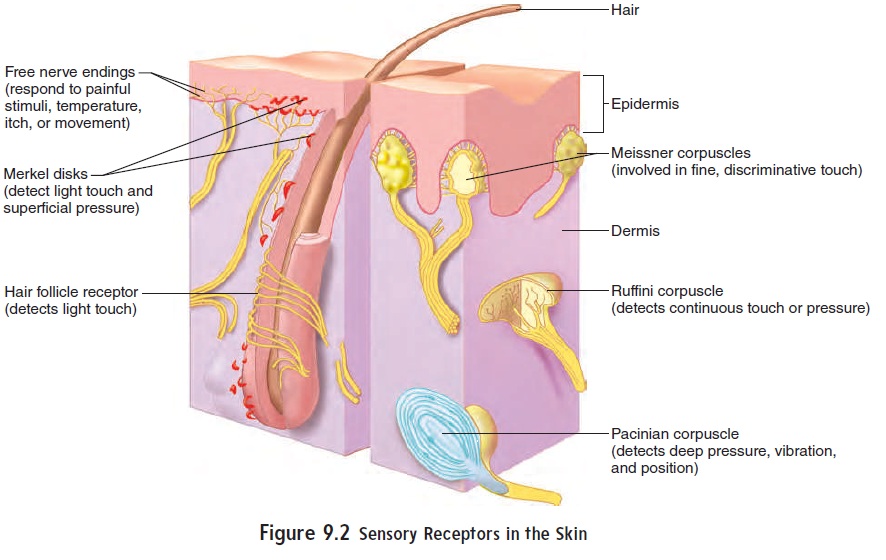
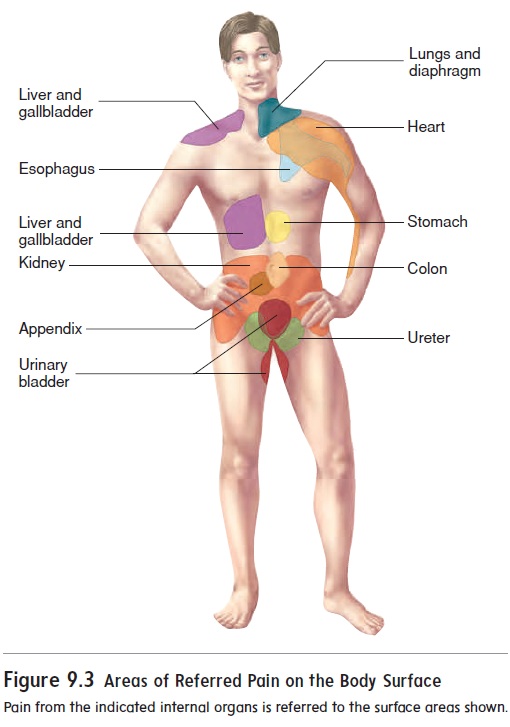
General SENSES The general senses accept sensory receptors that are widely distributed throughout the body. The general senses include the senses of touch, pressure, hurting, temperature, vibration, itch, and proprioception (pr ō -pr ē - ō -sep′ shun), which is the sense of movement and position of the body and limbs. Many of the receptors for the general senses are associated with the skin (figure 9.ii); others are associated with deeper structures, such as tendons, ligaments, and muscles. Structurally, the simplest and most common receptors arecostless nerve endings, which are relatively unspecialized neuronal branches similar to dendrites. Free nerve endings are distributed throughout almost all parts of the body. Some free nerve endings respond to painful stimuli, some to temperature, some to itch, and some to movement. Receptors for temperature are eithercold receptors orwarm receptors. Cold receptors respond to decreasing temperatures merely stop responding at temperatures below 12°C (54°F). Warm receptors answer to increasing temperatures merely stop responding at temperatures above 47°C (117°F). It is sometimes difficult to distinguish very cold from very warm objects touching the skin considering just pain receptors are stimulated at temperatures below 12°C or higher up 47°C. Impact receptors are structurally more than circuitous than free nerveendings, and many are enclosed by capsules. At that place are several types of touch receptors (effigy ix.2).Merkel disks are small-scale, superficial nerve endings involved in detecting light impact and superficial pressure.Hair follicle receptors, associated with hairs, are also involved in detecting low-cal touch. Low-cal touch receptors are very sensitive but non very discriminative, meaning that the point being touched cannot be precisely located. Receptors for fine, discrimina-tive touch, chosenMeissner corpuscles, are located just deep to the epidermis. These receptors are very specific in localizing tactile sensations. Deeper tactile receptors, calledRuffini corpuscles, play an important role in detecting continuous pressure level in the skin. The deepest receptors are associated with tendons and joints and are calledpacinian corpuscles. These receptors relay information concerning deep pressure level, vibration, and position (proprioception). Hurting is characterized past a group of unpleasant perceptual andemotional experiences. There are two types of hurting awareness:(1) localized, abrupt, pricking, or cutting pain resulting from speedily conducted action potentials, and (2) diffuse, burning, or aching pain resulting from activity potentials that are propagated more slowly. Superficial pain sensations in the peel are highly localized equally a result of the simultaneous stimulation of hurting receptors and tactile receptors. Deep or visceral pain sensations are not highly localized because of the absence of tactile receptors in the deeper structures. Visceral hurting stimuli are normally perceived equally diffuse pain. Action potentials from hurting receptors in local areas of the body tin be suppressed bylocal anesthesia, a treatment where chemic anesthetics are injected near a sensory receptor or nerve, resulting in reduced pain awareness. Pain sensations tin also be suppressed if loss of consciousness is produced. This is normally accomplished bygeneral anesthesia, a treatment where chemical anesthetics that touch the reticular formation are administered. Pain sensations tin can also exist influenced by inherent command systems. Sensory axons from tactile receptors in the skin take collateral branches that synapse with neurons in the posterior horn of the spinal cord. Those neurons, in turn, synapse with and inhibit neurons that requite rise to the spinothalamic tract, a sensory pathway that relays hurting sensations to the encephalon (see table 8.4). For example, rubbing the skin in the area of an injury stimulates the tactile receptors, which transport action potentials along the sensory axons to the spinal cord. According to thegate control theory, these activeness potentials "close the gate" and inhibit action poten-tials carried to the brain by the spinothalamic tract. The gate control theory may explain the physiological footing for several techniques that have been used to reduce the intensity of pain. Action potentials carried by the spinothalamic tract can be inhibited by action potentials carried by descending neurons of the dorsal column organisation . These neurons are stimulated by mental or physical action, especially involving motility of the limbs. The descending neurons synapse with and inhibit neurons in the posterior horn that give rise to the spinothalamic tract. Vigorous mental or physical activity increases the rate of action potentials in neurons of the dorsal column and can reduce the sensation of pain. Do programs are important components in the clinical man-agement of chronic hurting. Acupuncture and acupressure procedures may as well decrease the sensation of hurting by stimulating descending dorsal cavalcade neurons, which inhibit activeness potentials in the spino-thalamic tract neurons. The gate control theory as well explains why the intensity of pain is decreased by diverting a person'south attention. Referred pain is perceived to originate in a region of the body thatis non the source of the pain stimulus. Virtually normally, we sense referred pain when deeper structures, such as internal organs, are damaged or inflamed (effigy 9.iii). This occurs considering sensory neurons from the superficial area to which the pain is referred and the neurons from the deeper, visceral area where the pain stimula-tion originates converge onto the same ascending neurons in the spinal cord. The encephalon cannot distinguish betwixt the two sources of hurting stimuli, and the painful sensation is referred to the virtually superficial structures innervated, such as the skin. Referred pain is clinically useful in diagnosing the actual crusade of the painful stimulus. For example, during a heart attack, pain receptors in the heart are stimulated when blood catamenia is blocked to some of the middle muscle. Heart assault victims, however, often may not feel the pain in the heart but instead perceive cutaneous pain radiating from the left shoulder downwards the arm (figure 9.3).
Hurting
Referred Pain
Written report Material, Lecturing Notes, Consignment, Reference, Wiki description explanation, brief detail
Essentials of Beefcake and Physiology: Senses : Full general Senses |
Source: https://www.brainkart.com/article/General-Senses_21834/
0 Response to "Artlabeling Activity Types of General Sensory Receptors in the Skin"
Post a Comment