Full Page Advertisement Holland in 1994 Ny Times Ad Never Strike Again in 1994
| World Cup USA '94 | |
|---|---|
 1994 FIFA World Loving cup official logo | |
| Tournament details | |
| Host country | Usa |
| Dates | June 17 – July 17 |
| Teams | 24 (from 5 confederations) |
| Venue(s) | 9 (in 9 host cities) |
| Concluding positions | |
| Champions |  Brazil (4th title) Brazil (4th title) |
| Runners-up |  Italy Italy |
| Third identify |  Sweden Sweden |
| Fourth place |  Bulgaria Bulgaria |
| Tournament statistics | |
| Matches played | 52 |
| Goals scored | 141 (ii.71 per lucifer) |
| Omnipresence | 3,597,042 (69,174 per match) |
| Top scorer(s) | Hristo Stoichkov Oleg Salenko Oleg Salenko(vi goals each) |
| Best actor(due south) | Romário |
| Best young role player |  Marc Overmars Marc Overmars |
| Best goalkeeper |  Michel Preud'homme Michel Preud'homme |
| Fair play accolade | Brazil |
The 1994 FIFA Earth Cup was the 15th FIFA Globe Loving cup, the world championship for men's national soccer teams. It was hosted past the United States and took place from June 17 to July 17, 1994, at nine venues across the country. The The states was chosen every bit the host by FIFA on July 4, 1988. Despite soccer'southward relative lack of popularity in the host nation, the tournament was the near financially successful[1] [two] in World Cup history; it broke tournament records with overall attendance of 3,587,538 and an average of 68,991 per game,[three] marks that stood unbroken equally of 2018[4] despite the expansion of the contest from 24 to 32 teams starting with the 1998 World Cup.[5]
Brazil were crowned the winners after defeating Italy 3–2 in a punishment shoot-out at the Rose Basin in Pasadena, California near Los Angeles, after the game had ended 0–0 after extra time. It was the beginning Earth Cup last to exist decided on penalties. The victory made Brazil the first nation to win four World Cup titles. In that location were 3 new entrants in the tournament: Hellenic republic, Nigeria and Saudi Arabia plus Russia, post-obit the breakup of the Soviet Union, and for the first fourth dimension since 1938, a unified Germany took part in the tournament. They were besides defending champions, but were eliminated in quarter-finals by Republic of bulgaria. It was the kickoff Globe Cup where three points were awarded for a victory instead of 2 and also the beginning with the dorsum-laissez passer dominion. This was done to encourage a more than attacking style of soccer after the defensive tactics and depression-scoring matches of the 1990 World Cup. This resulted in an average of 2.71 goals per match.
Background and preparations [edit]
Behest process [edit]
Three nations bid for host duties: United states, Brazil, and Morocco.[six] The vote was held in Zurich on July 4, 1988, and just took one circular with the United States bid receiving a little over half of the votes past the FIFA Executive Committee members.[6] FIFA hoped that by staging the world'south most prestigious tournament there, it would lead to a growth of interest in the sport.[7]
An inspection committee too found that the proposed Brazilian stadiums were deficient, while the Moroccan bid relied on the structure of nine new stadiums. Conversely, all the proposed stadiums in the The states were already built and fully functioning; US Soccer spent $500 million preparing and organizing the tournament, far less than the billions other countries previously had spent and subsequently would spend on preparing for this tournament.[eight] The U.S. bid was seen as the favorite and was prepared in response to losing the right to exist the replacement host for the 1986 tournament following Colombia'south withdrawal.[9]
One status FIFA imposed was the cosmos of a professional person soccer league – Major League Soccer was founded in 1993 and began operating in 1996.[10] There was some initial controversy[11] about awarding the Globe Cup to a country where soccer was not a nationally popular sport, and at the time, in 1988, the U.S. no longer had a professional league; the North American Soccer League, established in 1967, had folded in 1984 after attendance faded.[11] The success of the 1984 Summer Olympics, particularly the soccer tournament that drew 1.4 million spectators throughout the event, likewise contributed to FIFA's decision.[12]
The Us had previously bid to host the 1986 FIFA Globe Cup, after Colombia withdrew equally the host nation in November 1982 because of economic concerns. Despite a presentation led by old North American Soccer League players Pelé and Franz Beckenbauer, likewise as erstwhile United States Secretarial assistant of State Henry Kissinger, the executive commission selected Mexico.[xiii]
Mascot [edit]
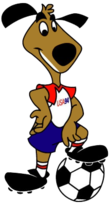
Striker, the official mascot of the tournament.
The official mascot of this World Cup was Striker, the World Loving cup Pup, a canis familiaris wearing a red, white and blue soccer uniform with a ball.[xiv] Striker was designed by the Warner Bros. animation team.[fifteen] A dog was picked as the mascot because dogs are a common pet in the Us.[fifteen]
[edit]
The sponsors of the 1994 FIFA World Loving cup were divided into 2 categories: FIFA World Loving cup Sponsors and USA supporters.
| FIFA Earth Cup sponsors | USA supporters |
|---|---|
|
|
The official game ball was the Adidas Questra.
Venues [edit]
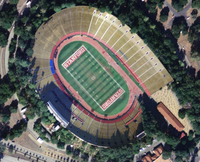
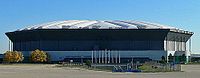
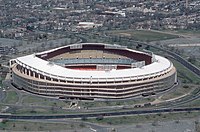
The games were played in 9 cities across the United States. All stadiums had a capacity of at least 53,000, and their usual tenants were professional or college American football teams.[19] Other considered venues in other major cities across the United States such equally Atlanta, Denver, Kansas Metropolis, Las Vegas, Miami, Minneapolis, New Orleans, Philadelphia, Seattle and Tampa were not used, likewise equally venues in smaller towns such as Annapolis, Maryland; Columbus, Ohio; Corvallis, Oregon; and New Oasis, Connecticut.[20] Several modern venues, including Joe Robbie Stadium in Miami and Candlestick Park in San Francisco were rejected because of conflicts with Major League Baseball, so Stanford Stadium, 30 miles (48 km) southeast of San Francisco was used,[21] [22] and the Citrus Basin in Orlando was picked over Miami's 2 submitted venues (the Orange Bowl, the other Miami venue, required major renovations to meet tournament standards).[23] The venue used most was the Rose Bowl in Pasadena, with eight games, among them one circular of sixteen game, a semi-concluding, the third-identify game, and the last. Giants Stadium near New York hosted 7 games including a semi-final; Boston (Foxborough), San Francisco (Stanford) and Dallas hosted six games each and Chicago, Washington and Orlando each hosted five games. The least used was the Pontiac Silverdome most Detroit, the offset indoor stadium used in a World Cup, with four group phase games. The Pontiac Silverdome was also the only venue of the ix used that did not host whatsoever knockout round games.
Because of the large expanse of the continental Us, the game locations were often far apart. Some teams in Groups A and B had to travel from Los Angeles or San Francisco all the way to Detroit and back once more, covering 2,300 miles (3,700 km) and four time zones. The teams in Groups C and D merely played in Foxborough (Boston), Chicago and Dallas—a trip from Boston to Dallas is 2,000 miles (three,200 km), but only covers two time zones; Chicago is in the same fourth dimension zone every bit Dallas but is still 1,000 miles (1,600 km) abroad from both Dallas and Boston. The teams in Groups E and F had it a bit easier—they played exclusively in New York (East Rutherford), Washington and Orlando, which while far apart are at least all in the same time zone. A few teams, such every bit Cameroon and Republic of colombia did not have to travel to cities beyond the country to play games.
The variety of climate in different cities all over the United states too sometimes made playing conditions challenging. Aside from the oceanic coolness of Boston (Foxborough), the Mediterranean climate of San Francisco (Stanford) and occasionally the coolness of Chicago, as they had been in Mexico in 1970 and 1986 most matches were played in hot and/or humid weather condition, cheers to nearly all of the games being scheduled to be played during the day instead of at night in order to adjust a fourth dimension difference compromise for television receiver in Europe, Africa, and the Eye East; this had always been done every time a Earth Loving cup was held in the Americas. Although playing in the mostly dry oestrus and smoggy weather of Los Angeles (Pasadena) and the mixture of heat and humidity of Washington and New York sometimes proved to exist difficult, the cities with the most consistently oppressive conditions were Orlando and Dallas in the South, because of the combination of rut and extreme humidity.[24] The Floridian tropical climate of Orlando meant all games at that place were played in temperatures of 95 °F (35 °C) or higher up with dew points to a higher place 70 or more than (the temperature there during the grouping phase game betwixt Mexico and Republic of ireland was 105 °F (41 °C)) thank you to the mid-24-hour interval kickoff times.[25] Dallas was not much different: in the humid rut of a Texas summertime, temperatures exceeded 100 °F (38 °C) during mid-solar day, when games there were staged in the open-type Cotton Bowl meant that conditions were just as oppressive at that place every bit they were in Orlando.[26] Detroit likewise proved to be difficult: the Pontiac Silverdome did non have a working cooling system and because it was an air-supported stadium, the air could not escape through circulation, so temperatures inside the stadium would climb past 90 °F (32 °C) with 40% humidity. United States midfielder Thomas Dooley described the Silverdome as "the worst place I accept ever played at".[27]
| Pasadena, California (Los Angeles) | Stanford, California (San Francisco) | Pontiac, Michigan (Detroit) | East Rutherford, New Bailiwick of jersey (New York/New Jersey) |
|---|---|---|---|
| Rose Basin | Stanford Stadium | Pontiac Silverdome | Giants Stadium |
| Chapters: 94,194 | Chapters: 84,147 | Capacity: 77,557 | Chapters: 76,322 |
 |  |  |  |
| Dallas, Texas | Pasadena Pontiac Stanford East Rutherford Orlando Chicago Dallas Foxborough Washington, D.C. 1994 FIFA Earth Cup (the United states of america) | ||
| Cotton Bowl | |||
| Capacity: 64,000 | |||
 | |||
| Chicago, Illinois | Orlando, Florida | Foxborough, Massachusetts (Boston) | Washington, D.C. |
| Soldier Field | Citrus Bowl | Foxboro Stadium | Robert F. Kennedy Memorial Stadium |
| Capacity: 63,160 | Chapters: 62,387 | Capacity: 54,456 | Capacity: 53,121 |
 |  |  |  |


Participating teams and officials [edit]
Qualification [edit]
3 teams: 1 African, one Asian, and i European, made their debuts at the 1994 tournament. Nigeria qualified from the African zone alongside Cameroon and Morocco as CAF was granted iii spots every bit a result of the strong performances past African teams in 1990. In the Asian zone, Saudi arabia qualified for the first fourth dimension by topping the last round group ahead of Republic of korea as both edged out Japan, who was close to making its own World Loving cup debut, merely was denied past Iraq in what became known as the "Agony of Doha". In the European zone, Greece made their showtime World Cup appearance after topping a group from which Russia as well qualified, competing independently for the showtime time later on the dissolution of the Soviet Union.
The defending champions Westward Germany were united with their East German counterparts, representing the unified Federal republic of germany for the first time since the 1938 World Loving cup. Norway qualified for the first time since 1938, Bolivia for the first time since 1950 (and the last time as of 2022), and Switzerland for the first time since 1966. Norway's 56-year gap between appearances in the concluding tournament equaled Arab republic of egypt'southward record in the previous tournament every bit the longest. Mexico had its first successful qualification campaign since 1978, failing to qualify in 1982, qualifying as hosts in 1986 and existence banned for the Cachirules scandal in 1990.
The qualification campaigns of both Czechoslovakia and Yugoslavia were affected past political events. The nation of Czechoslovakia dissolved in 1993, completing its qualifying group nether the name "Representation of Czechs and Slovaks" (RCS), simply failed to authorize for the finals, having been edged out by Romania and Belgium in Grouping 4. Yugoslavia (which was supposed to play in Group 5) was suspended from international contest in 1992 as part of United nations sanctions against the country as a issue of the Yugoslav Wars. The sanctions were not lifted until 1994, by which fourth dimension it was no longer possible for the team to qualify. Chile'due south pause from the 1990 FIFA World Cup, following the forced intermission of their qualification game against Brazil, extended to the 1994 qualifiers as well.
This was the first World Loving cup since Globe War 2 in which none of the UK Home Nations of England, Scotland, Northern Ireland and Wales qualified (they withdrew their FIFA memberships between 1928 and 1946, during the first three tournaments), with England (finishing 3rd behind Norway and Netherlands in Group 2) missing out after having finished 4th in the 1990 tournament, and Scotland (who finished quaternary in Group i) failing to qualify for the first time since 1970. France, who had been already designated equally hosts of the 1998 tournament, also missed out following surprise home losses to Israel and Republic of bulgaria. This was the 2nd World Cup in a row for which France had failed to qualify, and the last one to date to non feature England, France, and Japan. Other notable absentees were 1990 Round of sixteen participants Uruguay, UEFA Euro 1992 champions Denmark, Paraguay, Poland, Portugal and Republic of hungary.
List of qualified teams [edit]
The post-obit 24 teams, shown with final pre-tournament rankings,[28] qualified for the final tournamentː
Squads [edit]
Teams were selected post-obit usual FIFA rules with 22 players. Greece, Italia, Kingdom of saudi arabia, and Espana were the only countries that had all their players coming from domestic teams, while the Republic of Ireland and Nigeria had no players from domestic teams. Kingdom of saudi arabia was the merely squad with no players from European teams.
Seeding and cartoon [edit]
The composition of the 4 pots was based on the FIFA World Ranking (established in 1993) and on the qualified teams' results in the three previous World Cups. The teams' pre-tournament rankings are shown in parenthesis.[29] The principle of the draw was that each grouping must have at least 2 European teams, United States and United mexican states could not be drawn in the aforementioned grouping, while Brazil and Argentina could not exist drawn with another South American team.
| Pot ane (Superlative 5 + hosts) | Pot 2 (Africa + Americas) | Pot iii (Europe 1–6) | Pot 4 (Europe 7–ten + Asia) |
|---|---|---|---|
|
|
|
|
The drawing for the tournament took place at the Las Vegas Convention Center on December nineteen, 1993, officiated past general-secretary Sepp Blatter. Teams were drawn by German fable Franz Beckenbauer, heavyweight boxing champion Evander Holyfield and comedian and actor Robin Williams. Numbers for placement in the grouping were fatigued by actor Beau Bridges, Women's Earth Loving cup champion Michelle Akers, model Ballad Alt, artist Peter Max, racecar commuter Mario Andretti and Olympic gilded medalist in gymnastics Mary Lou Retton.[30] [31]
Referees [edit]
Summary [edit]
Despite the controversy, the U.S. staged a hugely successful tournament, with an average attendance of nearly 70,000 breaking a record that surpassed the 1966 FIFA World Loving cup average attendance of 51,000, thanks to the large seating capacities of the stadiums in the United States in comparison to the generally smaller venues of Europe and Latin America. To this day, the total omnipresence for the final tournament of well-nigh 3.6 million remains the highest in World Loving cup history, despite the expansion of the contest from 24 to 32 teams at the 1998 World Cup in France.[iv] [32] Germany, Brazil, Argentina, Belgium, Italy, and the Usa were seeded for the final depict, which took place in Las Vegas on December nineteen, 1993.[33]
The format of the competition stayed the same equally in the 1990 World Cup: 24 teams qualified, divided into half-dozen groups of 4. 16 teams would qualify for the knockout phase: the six group winners, the 6 group runners-up, and the four third-placed teams with the all-time records. This was the last time this format was used, due to the expansion of the finals tournament in 1998 to 32 teams. FIFA introduced three rule changes for this tournament to encourage attacking play: three points awarded for a win in a group stage match instead of 2, a relaxed offside rule and a ban on picking up dorsum-passes to goalkeepers. The number of goals increased to ii.73 per game from the record-low of 2.21 in 1990.[34]
The tournament saw the end of Diego Maradona'south World Loving cup career, having played in the 1982, 1986, and 1990 World Cups, and leading Argentina to the 1986 Globe Loving cup championship and the final of the 1990 World Loving cup. Maradona was expelled from the tournament subsequently he failed a drug examination which uncovered ephedrine, a weight-loss drug, in his blood. Republic of colombia, despite loftier expectations due to their style and impressive qualifying campaign, failed to advance from the round robin. The team was supposedly[ by whom? ] indomitable by influence from betting syndicates and drug cartels, with passenger vehicle Francisco Maturana receiving decease threats over squad selection.[ commendation needed ] Defender Andrés Escobar was a tragic figure[ to whom? ] of this tournament, as in the group phase game against the United states, he scored an ain goal that eliminated his team. Escobar was shot to death outside a bar in a Medellín suburb only 10 days later, apparently in retaliation for the own goal.[35]

Lothar Matthäus scoring a penalty kick in Germany's quarter-final confronting Bulgaria at Giants Stadium on July 10. Republic of bulgaria came back to win the game.
On the field, Republic of bulgaria was ane of the biggest surprises of the tournament. The Bulgarians had never won a game in five previous World Cup finals just, led by Hristo Stoichkov who somewhen shared the tournament atomic number 82 in scoring, they made a surprising[ to whom? ] run; Bulgaria won 2 of their iii grouping games to qualify for the second circular, where they avant-garde with a iii–one penalty shoot-out win over Mexico. Bulgaria then faced the reigning world champions, Germany, in the quarter-finals, where goals from Stoichkov and Yordan Letchkov gave them a 2–1 victory. Bulgaria went on to stop in fourth place later on losing to Italian republic and Sweden, in the semi-finals and 3rd-place game, respectively.
The host nation United States, after a 23rd place finish in Italy 1990, advanced to the 2d round every bit one of the best third-place teams. They were eliminated in the Round of xvi on a 1-0 defeat to Brazil on Independence Solar day.
Brazil's win over the hosts helped have them to the final confronting Italy. Brazil's path was relatively smooth though non easy,[ clarification needed ] equally they defeated the Netherlands in the quarter-finals and Sweden in the semis. The Italians meanwhile had fabricated difficult work of reaching the last. During the group phase, Italy struggled and narrowly advanced to the next round, despite losing 1–0 to the Ireland. Italian playmaker Roberto Baggio, who equally the reigning FIFA Earth Player of the Yr and Ballon D'Or holder, was expected[ by whom? ] to be one of the stars of the tournament,[ citation needed ] had non yet scored a goal. During the Round of 16 games against Nigeria, Italy was trailing ane–0 in the dying minutes when Baggio scored the tying goal, forcing the game into actress time. He scored again with a penalty kick to ship Italian republic through. Baggio carried the Italians from there, scoring the game-winning goal in the quarter-final against Spain, and both goals in Italian republic's semi-final victory over Republic of bulgaria.[36]
The third-place playoff was set between Bulgaria and Sweden, the team which scored more than goals than whatever other in this World Cup.[ quantify ] These teams had also previously met in the qualifying group. Sweden won, 4–0. Swedish forward Tomas Brolin was named to the All-star team.[37]
The final game at the Rose Bowl was tense but devoid of scoring chances. Information technology was the second time in 24 years that the 2 nations had met in a final. After 120 goalless minutes, the World Cup was decided for the starting time time past a punishment shoot-out. Later on four rounds, Brazil led 3–2, and Baggio, playing injured, had to score to keep Italy's hopes alive.[36] He missed by shooting it over the batten, and the Brazilians were crowned champions for the fourth time.[38] Later on the game ended, so-Vice-president Al Gore hosted the application ceremony by handing Brazilian captain Dunga the prestigious bays; the Brazilian national team defended the title to the deceased Formula I motor racing champion and countryman Ayrton Senna, who had died two and a half months prior.[ citation needed ]
The tournament's Golden Boot went jointly to Bulgaria'southward Stoichkov and Oleg Salenko of Russia, the latter becoming the first player to score five goals in a game, coming in a six–one victory confronting Cameroon. Both players scored six goals in the tournament. Brazilian striker Romário, with five goals, won the Golden Ball equally the tournament'southward all-time player.[38]
Opening ceremony [edit]
The opening anniversary of the Earth Loving cup was held on June 17 at Chicago'south Soldier Field. The ceremony was emceed by Oprah Winfrey, who brutal off the dais in introducing Diana Ross, who gave a musical operation. Ross was besides supposed to kick a soccer brawl into the goal from the penalty spot at the beginning of her performance, with the goal then splitting in 2 every bit role of a pre-orchestrated stunt. She kicked the ball wide to the left, missing the goal, but the goalposts were collapsed anyway in accordance with the stunt plans. In addition, Daryl Hall and Jon Secada also gave musical performances.[39] Information technology was officially opened past then-President Bill Clinton.[40]
Group stage [edit]
Times are Eastern Daylight Time (UTC−4) (Eastward Rutherford, Foxborough, Orlando, Pontiac and Washington), Primal Daylight Time (UTC−5) (Chicago and Dallas), and Pacific Daylight Time (UTC−7) (Pasadena and Stanford).

| Champion Runner-up | Tertiary identify Fourth place | Quarter-finals Round of xvi | Group stage |
In the post-obit tables:
- Pld = full games played
- W = full games won
- D = full games drawn (tied)
- L = total games lost
- GF = total goals scored (goals for)
- GA = total goals conceded (goals confronting)
- GD = goal difference (GF−GA)
- Pts = total points accumulated
Group A [edit]
The Group A game between the Us and Switzerland was the offset to take place indoors, played under the roof at the Pontiac Silverdome.
Following the tournament, Colombian defender Andrés Escobar was shot dead on his return to Colombia, subsequently his own goal had contributed to his country's elimination.
Victories against Colombia and the The states (in front of a crowd of 93,869) were plenty to see Romania through as group winners, despite a 4–1 hammering by Switzerland in betwixt. The magnitude of that victory immune Switzerland to move ahead of the United States on goal difference, although the hosts qualified for the second round as one of the best 3rd-placed teams.
Switzerland's 4–1 victory over Romania came nearly xl years to the date of Switzerland's last Earth Cup victory, as well a 4–one victory, on that occasion over Italian republic. The United States' 2–ane victory over Colombia was its offset World Cup victory since June 29, 1950, when it upset England 1–0 in the 1950 World Cup.
| Pos | Team | Pld | West | D | L | GF | GA | GD | Pts | Qualification |
|---|---|---|---|---|---|---|---|---|---|---|
| 1 |  Romania Romania | 3 | 2 | 0 | i | v | 5 | 0 | vi | Advance to knockout phase |
| 2 |  Switzerland Switzerland | 3 | 1 | 1 | 1 | 5 | 4 | +ane | 4 | |
| iii |  The states (H) The states (H) | three | 1 | i | 1 | 3 | three | 0 | 4 | |
| 4 |  Colombia Colombia | 3 | 1 | 0 | ii | 4 | 5 | −i | 3 |
Source: FIFA
(H) Host
| June 18, 1994 | |||
United States | 1–ane | Switzerland | Pontiac Silverdome, Pontiac |
| Colombia | 1–3 | Romania | Rose Bowl, Pasadena |
| June 22, 1994 | |||
| Romania | 1–iv | Switzerland | Pontiac Silverdome, Pontiac |
| United States | 2–1 | Colombia | Rose Bowl, Pasadena |
| June 26, 1994 | |||
| Switzerland | 0–ii | Colombia | Stanford Stadium, Stanford |
| Us | 0–one | Romania | Rose Bowl, Pasadena |
Grouping B [edit]
Group B produced two of the four semi-finalists of this World Cup — Brazil and Sweden — and was besides one of the two groups in which only 2, rather than iii, sides progressed to the second circular. The match between the two eliminated teams, Cameroon and Russia, broke 2 World Loving cup records. Oleg Salenko of Russia became the first – and remains the only[ citation needed ] – homo to score 5 goals in a single World Cup game as Russia won half-dozen–i. The goals also ensured that Salenko finished the tournament joint-elevation scorer with 6 goals, having previously bagged one against Sweden. Cameroon left a mark too every bit Roger Milla, at the historic period of 42, became the oldest World Cup goalscorer of all time, as he grabbed his side's consolation goal in the game. The result was not plenty to have Russia through following losses to Brazil and Sweden. Brazil vanquish Cameroon, and and so confirmed the top spot with a draw to Sweden.
The Swedes as well progressed, finishing in 2d place with five points. Sweden's 3–1 victory over Russia was the nation'due south first Earth Cup victory since July iii, 1974. Russia failed to progress to the second round for the 2d time, while Cameroon failed to repeat their surprise operation from the previous tournament.
| Pos | Team | Pld | Westward | D | L | GF | GA | GD | Pts | Qualification |
|---|---|---|---|---|---|---|---|---|---|---|
| 1 | Brazil | 3 | two | 1 | 0 | 6 | one | +5 | 7 | Accelerate to knockout phase |
| 2 | Sweden | iii | 1 | ii | 0 | 6 | 4 | +ii | v | |
| three | Russia | 3 | 1 | 0 | ii | vii | 6 | +ane | 3 | |
| 4 |  Cameroon Cameroon | three | 0 | one | 2 | 3 | eleven | −8 | 1 |
| June 19, 1994 | |||
| Republic of cameroon | ii–2 | Sweden | Rose Bowl, Pasadena |
| June xx, 1994 | |||
| Brazil | 2–0 | Russian federation | Stanford Stadium, Stanford |
| June 24, 1994 | |||
| Brazil | iii–0 | Cameroon | Stanford Stadium, Stanford |
| Sweden | 3–1 | Russia | Pontiac Silverdome, Pontiac |
| June 28, 1994 | |||
| Russia | 6–1 | Republic of cameroon | Stanford Stadium, Stanford |
| Brazil | i–1 | Sweden | Pontiac Silverdome, Pontiac |
Grouping C [edit]
As was the example with Group B, Group C would merely ship ii teams into the Round of 16 as Spain and defending champions Frg progressed to round 2. Coming from two goals down with iv minutes left to snatch a 2–two depict against Spain, the Southward Koreans very most eclipsed that feat confronting Deutschland when they came from three–0 downwards to lose narrowly iii–two. In spite of these comebacks, South Korea was held to a 0–0 draw confronting Bolivia in their other grouping game when a win would have seen them through. Spain's late implosion against the South Koreans effectively decided that it would be Germany who won the grouping and not them.
Germany, who defeated Bolivia one–0 in the tournament'due south opening game, finished with seven points. Spain had to settle for 2nd place despite leading in all 3 games.
Despite Bolivia finishing last in the group, Erwin Sanchez made team history later on scoring the nation's showtime Earth Cup goal in a 3–1 loss to Kingdom of spain. Prior to 1994, Republic of bolivia had never scored in either of their previous appearances at the 1930 and 1950 Earth Cups.
| Pos | Team | Pld | West | D | L | GF | GA | GD | Pts | Qualification |
|---|---|---|---|---|---|---|---|---|---|---|
| one |  Deutschland Deutschland | 3 | ii | ane | 0 | 5 | 3 | +2 | 7 | Advance to knockout stage |
| 2 |  Espana Espana | 3 | i | 2 | 0 | 6 | four | +2 | 5 | |
| 3 |  South Korea South Korea | 3 | 0 | 2 | 1 | iv | 5 | −1 | ii | |
| four |  Bolivia Bolivia | 3 | 0 | 1 | ii | 1 | iv | −3 | one |
| June 17, 1994 | |||
| Frg | 1–0 | Bolivia | Soldier Field, Chicago |
| Spain | ii–2 | South Korea | Cotton fiber Bowl, Dallas |
| June 21, 1994 | |||
| Federal republic of germany | 1–1 | Kingdom of spain | Soldier Field, Chicago |
| June 23, 1994 | |||
| South Korea | 0–0 | Bolivia | Foxboro Stadium, Foxborough |
| June 27, 1994 | |||
| Republic of bolivia | 1–3 | Spain | Soldier Field, Chicago |
| Federal republic of germany | 3–2 | South Korea | Cotton wool Bowl, Dallas |
Group D [edit]
Tournament favorites Argentine republic led by Diego Maradona collected a maximum of six points from their opening 2 games after dominating Greece iv–0 in Foxboro with a Gabriel Batistuta hattrick before winning a close friction match against a formidable Nigeria with a 2–1 victory on the same field four days later; despite this Argentina finished tertiary in the group. Nigeria had been very impressive on their World Cup debut, and despite the narrow loss to Argentina, had emerged equally group winners post-obit victories against Bulgaria and Hellenic republic, the latter in which Nigeria doubled its lead late on a goal from Daniel Amokachi – a goal that would allow Nigeria to top its group. Maradona only played with Argentina during their get-go two games, both in Foxborough (playing Greece and Nigeria and scoring his last ever World Loving cup goal against the former); he was thrown out of the tournament after testing positive for ephedrine.
Having qualified for the tournament through a last-gasp goal against France, Bulgaria surprised many people, as the nation had never even won a game at the World Cup finals prior to this tournament. Despite losing its opening game 3–0 to Nigeria, Bulgaria came back in fashion with a 4–0 win over Hellenic republic (who had suffered exactly the same fate five days earlier against Argentina), and a 2–0 win against Argentina saw them advance. Argentina had really been winning the group going into injury time, while Bulgaria played the last 25 minutes with 10 men; all the same, a 91st-minute header from Nasko Sirakov meant that Argentina dropped two places and finished third. Nigeria won the group on goal difference. Bulgaria'south victory over Argentina earned them second place.
| Pos | Squad | Pld | W | D | L | GF | GA | GD | Pts | Qualification |
|---|---|---|---|---|---|---|---|---|---|---|
| 1 |  Nigeria Nigeria | 3 | 2 | 0 | ane | vi | 2 | +4 | 6 | Advance to knockout stage |
| 2 | Bulgaria | iii | 2 | 0 | i | half dozen | 3 | +3 | vi | |
| 3 |  Argentina Argentina | 3 | 2 | 0 | i | 6 | 3 | +3 | 6 | |
| 4 |  Greece Greece | three | 0 | 0 | three | 0 | 10 | −10 | 0 |
| June 21, 1994 | |||
| Argentina | four–0 | Greece | Foxboro Stadium, Foxborough |
| Nigeria | 3–0 | Bulgaria | Cotton wool Bowl, Dallas |
| June 25, 1994 | |||
| Argentina | 2–i | Nigeria | Foxboro Stadium, Foxborough |
| June 26, 1994 | |||
| Bulgaria | 4–0 | Greece | Soldier Field, Chicago |
| June 30, 1994 | |||
| Argentina | 0–2 | Bulgaria | Cotton Bowl, Dallas |
| Hellenic republic | 0–ii | Nigeria | Foxboro Stadium, Foxborough |
Group E [edit]

Italian republic and Norway getting gear up to play at Giants Stadium
Group E remains the but group in World Cup history in which all four teams finished with the aforementioned points and same goal difference. Information technology began at Giants Stadium where Ray Houghton's chip ensured a stupor Irish victory over the then-three-time champions Italian republic by 1–0, as well as gaining a measure out of revenge for the previous Earth Cup, in which Italy both hosted and eliminated Republic of ireland at the quarter-final stage. The next day in Washington, Norway played its first Globe Loving cup game since 1938 and Kjetil Rekdal'due south goal five minutes from time proved decisive in an every bit tense run across as Norway crush Mexico.
In the second round of grouping play, the tropical weather of Orlando played a fundamental factor for Mexico in their side by side game against Ireland. The match was held in record-breaking oestrus and humidity, temperatures in which the Mexicans were accustomed to but visibly uncomforted the Irish. Luis García'southward double had them 2–0 up and in control of the game before a disagreement on the touchline resulted in fines for both Republic of Ireland's managing director, Jack Charlton, and their striker John Aldridge. Aldridge was able to regain concentration in time to score six minutes from the terminate of the game to brand it 2–1. Despite their loss, Aldridge'due south goal proved crucial to Ireland in the final group standings.
During the previous mean solar day at Giants Stadium in New Jersey, Italia's World Cup hopes seemed to be diminishing fast as goalkeeper Gianluca Pagliuca was sent off with the game however at 0–0. All the same despite this, Italy was all the same able to salvage an important 1–0 victory. Kingdom of norway would ultimately pay a price for their inability to take reward of Pagliuca'southward dismissal. With the four teams level on points, the terminal 2 group games would each have to end every bit draws for things to stay that way. Republic of Ireland fabricated it through after a dreary 0–0 describe with Kingdom of norway; midfielders Massaro and Bernal traded strikes as Italy and Mexico played to a 1–1 describe.
Those results meant that Mexico won the group on goals scored, with three in the group. With Ireland and Italia as well progressing having finished with identical records, the Irish squad qualified equally 2d identify equally a result of their victory confronting the Italians. Norway'southward shortcomings in attack ultimately let them down, and they exited the tournament with only one goal.
| Pos | Team | Pld | W | D | 50 | GF | GA | GD | Pts | Qualification |
|---|---|---|---|---|---|---|---|---|---|---|
| 1 |  Mexico Mexico | 3 | 1 | 1 | 1 | 3 | iii | 0 | iv | Advance to knockout stage |
| two |  Commonwealth of Ireland Commonwealth of Ireland | three | ane | 1 | 1 | two | 2 | 0 | iv | |
| 3 | Italy | 3 | i | 1 | one | two | ii | 0 | 4 | |
| four |  Norway Norway | 3 | 1 | 1 | 1 | ane | i | 0 | iv |
| June 18, 1994 | |||
| Italian republic | 0–i | Republic of Ireland | Giants Stadium, E Rutherford |
| June xix, 1994 | |||
| Norway | ane–0 | United mexican states | RFK Stadium, Washington |
| June 23, 1994 | |||
| Italian republic | 1–0 | Kingdom of norway | Giants Stadium, E Rutherford |
| June 24, 1994 | |||
| Mexico | 2–1 | Democracy of Ireland | Citrus Basin, Orlando |
| June 28, 1994 | |||
| Italia | 1–1 | Mexico | RFK Stadium, Washington |
| Republic of Republic of ireland | 0–0 | Norway | Giants Stadium, East Rutherford |
Grouping F [edit]
Just as happened to Argentina in Grouping D, Kingdom of belgium endured the aforementioned fate in Grouping F. Despite winning both of its first two matches ane–0 against Morocco and neighbors Netherlands, Belgium finished third as, in an upset, it lost to tournament newcomers Saudi Arabia 1–0 in the third game. During that game, Saudi actor Saaed Al-Owairian ran from his ain one-half through a maze of Belgian players to score the game'south only goal.
Saudi Arabia advanced through to the Round of 16 likewise, having also defeated Morocco 2–1. The netherlands endured a somewhat nervier feel. The opening 2–1 victory against Saudi Arabia was followed by the 1–0 loss against Belgium before another ii–ane victory confronting Morocco, with Bryan Roy scoring the winner a mere 12 minutes from time, saw the Dutch win the group having scored more goals than Belgium and beaten Saudi Arabia. Morocco, despite losing all 3 of their grouping games, did non leave without a fight, as each of their losses were past but a single goal, 1–0 to Belgium, 2–1 to Saudi arabia, and two–1 to the Netherlands.
| Pos | Team | Pld | W | D | L | GF | GA | GD | Pts | Qualification |
|---|---|---|---|---|---|---|---|---|---|---|
| i | Netherlands | 3 | 2 | 0 | 1 | four | 3 | +1 | 6 | Advance to knockout stage |
| 2 |  Kingdom of saudi arabia Kingdom of saudi arabia | 3 | 2 | 0 | i | four | 3 | +1 | 6 | |
| iii | Belgium | 3 | 2 | 0 | 1 | 2 | 1 | +1 | 6 | |
| 4 |  Morocco Morocco | 3 | 0 | 0 | 3 | 2 | 5 | −3 | 0 |
| June 19, 1994 | |||
| Belgium | one–0 | Morocco | Citrus Basin, Orlando |
| June 20, 1994 | |||
| Netherlands | ii–one | Kingdom of saudi arabia | RFK Stadium, Washington |
| June 25, 1994 | |||
| Saudi Arabia | 2–1 | Morocco | Giants Stadium, Eastward Rutherford |
| Belgium | one–0 | Netherlands | Citrus Bowl, Orlando |
| June 29, 1994 | |||
| Belgium | 0–1 | Saudi Arabia | RFK Stadium, Washington |
| Kingdom of morocco | i–2 | Netherlands | Citrus Bowl, Orlando |
Ranking of third-placed teams [edit]
| Pos | Grp | Team | Pld | W | D | 50 | GF | GA | GD | Pts | Qualification |
|---|---|---|---|---|---|---|---|---|---|---|---|
| 1 | D | Argentine republic | 3 | ii | 0 | 1 | 6 | 3 | +3 | six | Accelerate to knockout phase |
| 2 | F | Kingdom of belgium | 3 | 2 | 0 | ane | 2 | 1 | +i | 6 | |
| 3 | A | United States | 3 | 1 | ane | 1 | 3 | 3 | 0 | 4 | |
| 4 | E | Italy | 3 | one | ane | 1 | 2 | 2 | 0 | iv | |
| five | B | Russia | 3 | one | 0 | 2 | vii | vi | +one | iii | |
| 6 | C | Republic of korea | 3 | 0 | 2 | one | 4 | 5 | −1 | two |
Knockout stage [edit]
| Round of 16 | Quarter-finals | Semi-finals | Final | |||||||||||
| 3 July – Pasadena | ||||||||||||||
| Romania | 3 | |||||||||||||
| ten July – Stanford | ||||||||||||||
| Argentina | 2 | |||||||||||||
| Romania | two (iv) | |||||||||||||
| 3 July – Dallas | ||||||||||||||
| Sweden (p) | two (v) | |||||||||||||
| Saudi arabia | 1 | |||||||||||||
| xiii July – Pasadena | ||||||||||||||
| Sweden | 3 | |||||||||||||
| Sweden | 0 | |||||||||||||
| 4 July – Orlando | ||||||||||||||
| Brazil | 1 | |||||||||||||
| Netherlands | 2 | |||||||||||||
| ix July – Dallas | ||||||||||||||
| Democracy of Republic of ireland | 0 | |||||||||||||
| Netherlands | two | |||||||||||||
| 4 July – Stanford | ||||||||||||||
| Brazil | 3 | |||||||||||||
| Brazil | 1 | |||||||||||||
| 17 July – Pasadena | ||||||||||||||
| U.s.a. | 0 | |||||||||||||
| Brazil (p) | 0 (3) | |||||||||||||
| five July – E Rutherford | ||||||||||||||
| Italia | 0 (2) | |||||||||||||
| Mexico | one (1) | |||||||||||||
| ten July – East Rutherford | ||||||||||||||
| Republic of bulgaria (p) | 1 (three) | |||||||||||||
| Bulgaria | 2 | |||||||||||||
| 2 July – Chicago | ||||||||||||||
| Germany | 1 | |||||||||||||
| Deutschland | 3 | |||||||||||||
| 13 July – E Rutherford | ||||||||||||||
| Belgium | two | |||||||||||||
| Republic of bulgaria | 1 | |||||||||||||
| five July – Foxborough | ||||||||||||||
| Italia | 2 | Third place | ||||||||||||
| Nigeria | 1 | |||||||||||||
| 9 July – Foxborough | 16 July – Pasadena | |||||||||||||
| Italy (aet) | 2 | |||||||||||||
| Italy | 2 | Sweden | 4 | |||||||||||
| 2 July – Washington | ||||||||||||||
| Spain | i | Bulgaria | 0 | |||||||||||
| Spain | 3 | |||||||||||||
| Switzerland | 0 | |||||||||||||
Round of sixteen [edit]
Quarter-finals [edit]
Semi-finals [edit]
3rd identify play-off [edit]
Last [edit]
Statistics [edit]
Goalscorers [edit]
Hristo Stoichkov and Oleg Salenko received the Golden Boot for scoring six goals.[41] In total, 141 goals were scored by 81 players, with only one of them credited as an own goal.
6 goals
5 goals
4 goals
three goals
ii goals
1 goal
Own goals
- Andrés Escobar (against the Usa)
Awards [edit]
| Golden Shoe | Aureate Brawl | Yashin Award | All-time Young Player | FIFA Fair Play Trophy | Most Entertaining Team |
|---|---|---|---|---|---|
| Hristo Stoichkov Oleg Salenko | Romário | Michel Preud'homme | Marc Overmars | Brazil | Brazil |
All-star team [edit]
The All-star team is a squad consisting of the eleven most impressive players at the 1994 World Cup, equally selected by FIFA's Technical Report Group.
| Goalkeeper | Defenders | Midfielders | Forrad |
|---|---|---|---|
| | | | |
Last standings [edit]
After the tournament, FIFA published a ranking of all teams that competed in the 1994 World Loving cup finals based on progress in the competition, overall results and quality of the opposition.[42]
| R | Team | Thousand | P | Westward | D | L | GF | GA | GD | Pts. |
|---|---|---|---|---|---|---|---|---|---|---|
| one | Brazil | B | 7 | 5 | two | 0 | 11 | 3 | +8 | 17 |
| 2 | Italia | E | 7 | 4 | 2 | one | eight | 5 | +3 | fourteen |
| three | Sweden | B | vii | three | iii | 1 | 15 | 8 | +7 | 12 |
| 4 | Bulgaria | D | 7 | iii | 1 | 3 | 10 | 11 | −i | 10 |
| Eliminated in the quarter-finals | ||||||||||
| 5 | Germany | C | 5 | iii | i | ane | 9 | 7 | +2 | 10 |
| six | Romania | A | 5 | iii | 1 | i | 10 | 9 | +1 | 10 |
| 7 | Netherlands | F | 5 | 3 | 0 | two | viii | 6 | +ii | 9 |
| viii | Spain | C | 5 | 2 | ii | 1 | 10 | 6 | +4 | 8 |
| Eliminated in the round of xvi | ||||||||||
| 9 | Nigeria | D | 4 | ii | 0 | ii | 7 | 4 | +iii | 6 |
| ten | Argentina | D | 4 | 2 | 0 | 2 | 8 | 6 | +ii | 6 |
| eleven | Belgium | F | four | 2 | 0 | two | 4 | 4 | 0 | 6 |
| 12 | Saudi Arabia | F | 4 | 2 | 0 | 2 | 5 | 6 | −1 | 6 |
| 13 | Mexico | E | iv | one | 2 | i | four | four | 0 | 5 |
| 14 | United States | A | four | i | i | 2 | 3 | 4 | −i | 4 |
| fifteen | Switzerland | A | 4 | ane | 1 | 2 | 5 | vii | −2 | 4 |
| 16 | Republic of Ireland | E | iv | 1 | 1 | 2 | ii | 4 | −2 | 4 |
| Eliminated in the group stage | ||||||||||
| 17 | Norway | Eastward | 3 | one | 1 | i | 1 | 1 | 0 | 4 |
| 18 | Russia | B | three | 1 | 0 | 2 | seven | six | +1 | 3 |
| 19 | Colombia | A | 3 | ane | 0 | 2 | 4 | 5 | −ane | 3 |
| xx | South Korea | C | 3 | 0 | 2 | one | iv | v | −1 | two |
| 21 | Bolivia | C | 3 | 0 | 1 | 2 | 1 | 4 | −3 | 1 |
| 22 | Cameroon | B | 3 | 0 | ane | two | iii | 11 | −8 | ane |
| 23 | Morocco | F | 3 | 0 | 0 | iii | 2 | 5 | −3 | 0 |
| 24 | Hellenic republic | D | 3 | 0 | 0 | iii | 0 | x | −ten | 0 |
Disciplinary statistics [edit]
- Total number of xanthous cards: 235
- Average yellow cards per game: four.52
- Total number of scarlet cards: 15
- Average red cards per lucifer: 0.29
- Kickoff yellow card of the tournament: Jürgen Kohler – Germany against Bolivia
- First cherry-red carte du jour of the tournament: Marco Etcheverry – Bolivia confronting Federal republic of germany
- Fastest xanthous card from kicking off: 1 minute – Sergei Gorlukovich – Russia against Sweden
- Fastest yellow card after coming on as substitute: 2 minutes – Daniel Borimirov – Bulgaria against Greece (introduced in the 82nd minute)
- Latest yellow card in a game without extra fourth dimension: 90 minutes – José Luis Caminero – Spain against Bolivia, Yuri Nikiforov – Russia against Cameroon, Mohamed Al-Deayea – Saudi Arabia against Morocco
- Latest yellow carte du jour in a game with extra time: 108 minutes – Basarab Panduru – Romania confronting Sweden
- Fastest dismissal from kick off: 21 minutes – Gianluca Pagliuca – Italy against Norway
- Fastest dismissal of a substitute: iii minutes – Ion Vlădoiu – Romania confronting Switzerland (introduced in the 80th minute)
- Latest dismissal in a game without extra time: 89 minutes – Gustavo Quinteros – Bolivia confronting Germany
- Latest dismissal in a game with extra fourth dimension: 101 minutes – Stefan Schwarz – Sweden confronting Romania
- Least time deviation between ii yellow cards given to the same player: 21 minutes – Fernando Clavijo – United States confronting Brazil (booked in the 64th infinitesimal and again in the 85th minute)
- Most yellowish cards (squad): 23 – Republic of bulgaria
- Most red cards (team): 2 – Bolivia, Bulgaria, Italia, Sweden
- Fewest yellowish cards (team): 5 – Republic of cameroon
- Most yellowish cards (thespian): iv – Zlatko Yankov
- Most red cards (histrion): 1 – Fernando Clavijo, Luis Cristaldo, Marco Etcheverry, Luis García, Sergei Gorlukovich, Emil Kremenliev, Leonardo, Miguel Ángel Nadal, Gianluca Pagliuca, Stefan Schwarz, Rigobert Song, Jonas Thern, Tsanko Tsvetanov, Ion Vlădoiu, Gianfranco Zola
- Near yellow cards (friction match): 10 – Mexico vs Republic of bulgaria
- About red cards (match): 2 – United mexican states vs Republic of bulgaria
- Fewest yellow cards (friction match): 1 – Netherlands vs Republic of Ireland
- Most cards in ane match: 10 yellow cards and 2 red cards – Mexico vs Bulgaria
Aftermath and legacy [edit]

The large capacity stadiums enabled huge, enthusiastic crowds to nourish the games, such every bit this i at the Giants Stadium quarter-final game.
- Although USA '94 marked the seventh time FIFA hosted the World Loving cup in the Americas (after beingness held in Uruguay, Brazil, Chile, Argentine republic, and twice by Mexico in 1970 and 1986), the U.s.a. became the first host in the American continent outside of the Latin American spectrum, and the first in the Anglosphere outside of England.
- The United States–Switzerland game on June eighteen at the Pontiac Silverdome was the first to exist played indoors in World Cup history: grass was grown by Michigan State University and was the showtime time since 1965 (the failed attempt at the Astrodome) that natural turf was used in an indoor stadium in the United States. To date, only Sapporo Dome in 2002 and Arena AufSchalke in 2006 have afterwards hosted indoor games in World Loving cup history.
- Oleg Salenko of Russian federation became the first player to score five goals in a single Globe Cup finals game in his state'due south group stage win over Cameroon. Republic of cameroon'due south Roger Milla as well scored a goal in the same game, becoming the oldest player to score a goal in a World Loving cup. At 42, he was besides the oldest player to appear in a World Cup, a record held until 2014, when Faryd Mondragón (43 years, three days) of Colombia broke the record in their game against Japan at the 2022 FIFA World Cup. In turn, goalkeeper Essam El Hadary (45 years, 161 days) of Egypt would surpass Mondragón against Kingdom of saudi arabia, in the Volgograd Arena, Volgograd, Russia, on June 25, 2018. All the same, Milla remains to be the oldest outfield player to perform in the Earth Cup.
- For the first fourth dimension, during the entering of the players onto the field, the FIFA Anthem, composed by Franz Lambert, was played.
- Gianluca Pagliuca of Italia became the first goalkeeper to be sent off in a World Cup game, dismissed for treatment exterior his surface area confronting Kingdom of norway.
- Brazil'southward 11 goals in their seven games was a record for the lowest average goals scored per game for whatever World Cup-winning side, simply this record was cleaved past Spain'due south 8 goals in 2010. The iii goals Brazil conceded in those seven games was at the time also the lowest average goals conceded per game, although this was afterwards surpassed by France in 1998, Italy in 2006, and Spain in 2010.
- The finals were the first fourth dimension FIFA decided to experiment with the style of jerseys worn by officials, foregoing the traditional black. They could choose betwixt burgundy, yellow or silverish shirts depending on what was necessary to avoid a disharmonism of colors with the two competing teams. This custom has since been followed, but with black shirts added as an selection later on.
- The finals were likewise the offset fourth dimension that players had their shirt numbers printed on the middle front (or on the right or left chest, in Kingdom of morocco's and Russia's case respectively) of the shirt, besides equally their names printed on the dorsum of their jerseys in a World Cup, just as other American sports did, to brand their identification easier for sportscasters. This custom followed from Euro 92, and has followed ever since (although numbers printed on the center front end had been experimented during the 1991 FIFA U-20 World Cup held in Portugal).
- The finals were the showtime to award 3 points for a win in the grouping stage to motivate teams to play an attacking fashion.
- In disciplinary matters, for the first time yellow cards accumulated in the group stage were wiped clean after its completion, and players started with a clean slate at the start of the knockout stage. Previously, players were suspended for one game if accumulating ii yellowish cards throughout the tournament. Now, players were suspended for one game after accumulating two yellow cards in the grouping stage, or ii yellow cards in the knockout phase. This was in response to the situation in 1990, where players such as Claudio Caniggia and Paul Gascoigne were suspended for the after games.
- The 1994 World Cup revolutionized goggle box coverage of sports in the U.s.a. through the sponsored scoreboard and game clock that were constantly shown on screen throughout the game. Television sports coverage in the United States had long been dependent upon commercial breaks, a feature suitable for sports such as baseball, basketball, ice hockey and American football (which all take breaks in the action), but long considered incompatible with soccer, due to the long stretches of uninterrupted play. Variations on information technology were quickly incorporated into about every team sports broadcast by the decade's end. The first American pro sports broadcaster to do this was Flim-flam Sports which won national rights to broadcast the NFL's National Football Conference from CBS six months before the 1994 Earth Cup began.
- The 1994 Earth Cup final was the start (and to date only) goalless final in World Cup history. Information technology was as well the showtime to be decided by a punishment shootout, the other beingness the 2006 FIFA World Cup Final. Italy took part in both games, and won the latter.
- This was the terminal World Cup in which games other than the terminal two in each grouping were played simultaneously, although this only happened once in this tournament: Kingdom of saudi arabia v Kingdom of morocco and Kingdom of belgium five Netherlands in Group F. From France '98 onwards, each game in the showtime two rounds of group play and the whole knockout stage have been played separately to maximize tv audiences.
- This was the last World Cup featuring 24 nations, and the last in which third-placed teams were however able to progress to the round of sixteen. From 1998 on, at that place were 32 nations, with only the top two in each grouping progressing.
- This was the beginning and the final Earth Cup, in which both teams, taking parts in third-place terminal, Sweden and Bulgaria, received bronze medals.
See also [edit]
- Soccer in the United States
- 1999 FIFA Women'southward World Cup
- Copa América Centenario – First edition of the Copa América hosted within the Us
- 2026 FIFA Globe Loving cup – an upcoming tournament to exist co-hosted by the United States, United mexican states and Canada.
References [edit]
- ^ "World Cup Moments, 1994: Penalties determine depression central only financially successful American tournament - The Republic of malta Independent". www.contained.com.mt.
- ^ McMullen, Paul. "U.Due south. Cup brimming with profits World Loving cup 1994". baltimoresun.com.
- ^ Brewin, John; Martin Williamson (April 30, 2014). "World Cup History: 1994". ESPN.com . Retrieved June 25, 2020.
- ^ a b "FIFA World Cup™ comparative statistics 1982-2014" (PDF). FIFA. Retrieved June 25, 2020.
- ^ Das, Andrew (April 8, 2017). "U.S., Mexico and Canada Likely to Affirm Joint World Cup Bid". The New York Times . Retrieved June 25, 2020.
- ^ a b "FIFA World Cup host declaration conclusion" (PDF). FIFA.com. Fédération Internationale de Football Association. p. 2. Archived from the original (PDF) on July 22, 2012. Retrieved Jan 30, 2013.
- ^ Lewis, Michael (July 4, 2015). "How USA was chosen to host Earth Cup 94: the within story of a historic solar day". The Guardian . Retrieved October 8, 2020.
- ^ Czuczka, Tony (July 5, 1988). "History's made, now piece of work begins: U.S. soccer savoring '94 Globe Cup bid". Seattle Mail service-Intelligencer. Associated Press. p. D2.
- ^ Cress, Doug (March thirteen, 1988). "U.Due south. Soccer officials expect to land 1994 World Cup". The Seattle Times. p. D12.
- ^ Agovino, Michael J. (July 4, 2018). "Does the Usa actually deserve to host some other World Loving cup?". Washington Post . Retrieved October 8, 2020.
- ^ a b McCartney, Robert J. (July 5, 1988). "U.S. TO HOST 1994 SOCCER WORLD CUP". Washington Post . Retrieved October 8, 2020.
- ^ Janofsky, Michael (July 5, 1988). "U.S. Awarded '94 Earth Loving cup Tourney in Soccer". New York Times . Retrieved Oct 8, 2020.
- ^ Berkowitz, Steve (July 10, 1988). "HOW THE U.S. WON THE WORLD CUP". Washington Post . Retrieved Oct 8, 2020.
- ^ Wojciech Dzierzbicki Fifteen FIFA Earth Cup (United states of america '94) Archived May 23, 2002, at the Wayback Machine World Cup History Page
- ^ a b "Funny... Information technology Doesn't Await Like Football" (PDF) . Retrieved March 2, 2012.
- ^ Group, Career Communications. "U.s. Blackness Engineer & IT". Career Communications Grouping – via Google Books.
- ^ "timeline_of_sun_microsystems_history – Devtome". devtome.com.
- ^ Inc, InfoWorld Media Group (June thirteen, 1994). "InfoWorld". InfoWorld Media Grouping, Inc. – via Google Books.
- ^ "WORLD CUP United states 1994: A Tale of Nine Cities". Los Angeles Times. July 10, 1994.
- ^ "THE 1994 BID: How the U.S. got the World Cup". frontrowsoccer.com. March 24, 1992. p. D1.
- ^ "Baseball'southward key part in World Loving cup sites". San Francisco Examiner. March 24, 1992. p. D1.
- ^ Chapin, Dwight (March 23, 1992). "Stanford to host World Cup in 1994". San Francisco Examiner. p. A1.
- ^ "World Cup gives Jrs the kick: Miami rejected because of conflict with Marlins". Sunday Sentinel. March 24, 1992.
- ^ "WORLD Loving cup USA 1994: The Best and the Worst". Los Angeles Times. July 14, 1994.
- ^ "Is Qatar too hot for the World Cup?". Channel four News. August x, 2013.
- ^ "The states 1994 was a Earth Loving cup of scorched feet and sweaty fans". Play tricks News. May 29, 2014.
- ^ "The summer that inverse U.S. soccer forever". March iv, 2014.
- ^ "FIFA/Coca Cola Globe Ranking (xiv June 1994)". FIFA.com. Fédération Internationale de Football game Clan. January 27, 2012. Archived from the original on June eighteen, 2015.
- ^ "FIFA/Coca-Cola Earth Ranking (14 June 1994)". FIFA.com. Fédération Internationale de Football Association. May 2, 2013. Archived from the original on Oct vii, 2011.
- ^ Arnold, P. FIFA World Cup USA 94 The Official Volume. Pp.12. Collins: San Francisco. ISBN 0-00-255231-0
- ^ "Looking Back at the 1994 FIFA Earth Cup Draw". www.ussoccer.com.
- ^ "Previous World Cups", FIFA.com. Retrieved November 21, 2013
- ^ History of the Earth Cup Terminal Draw FIFA
- ^ Graham, Bryan Armen (June 13, 2018). "USA 94: the World Cup that distracted Americans from Oprah and OJ". The Guardian . Retrieved January 11, 2021.
- ^ "Earth Cup Hall of Fame – Andrés Escobar (1967–1994)]". CNNSI.com. May 8, 2002. Archived from the original on October 22, 2002. Retrieved June 25, 2020.
- ^ a b "Divine past moniker, divine past magic". FIFA.com. Retrieved June 12, 2014
- ^ "FIFA Globe Cup All-Star Team – Football game world Loving cup All Star Team". Football game sporting 99. Archived from the original on June 30, 2016. Retrieved June 12, 2014.
- ^ a b "Romario is legen......dary" Archived January 4, 2014, at the Wayback Machine. Play a trick on Sports. Retrieved Nov 19, 2013
- ^ Graham, Bryan Armen (June 13, 2018). "U.s.a. 94: the World Cup that distracted Americans from Oprah and OJ". The Guardian. Guardian News & Media. Retrieved August 25, 2019.
- ^ Christian, Colin McMahon and Sue Ellen. "CHICAGO SAYS WELCOME TO THE WORLD". chicagotribune.com . Retrieved Apr 19, 2021.
- ^ "1994 FIFA World Cup USA: Awards". FIFA. Archived from the original on February 4, 2015. Retrieved July 16, 2015.
- ^ "All-fourth dimension FIFA World Loving cup Ranking 1930–2010" (PDF). Fédération Internationale de Football Association. Archived from the original (PDF) on June 17, 2012. Retrieved January 31, 2013.
External links [edit]
- 1994 FIFA World Cup USA, FIFA.com
- 1994 World Loving cup details RSSSF
- FIFA Technical Study (Part one), (Function ii), (Part three) and (Part 4)
- The outcome at SVT'southward open up archive (in Swedish)
Source: https://en.wikipedia.org/wiki/1994_FIFA_World_Cup
0 Response to "Full Page Advertisement Holland in 1994 Ny Times Ad Never Strike Again in 1994"
Post a Comment